

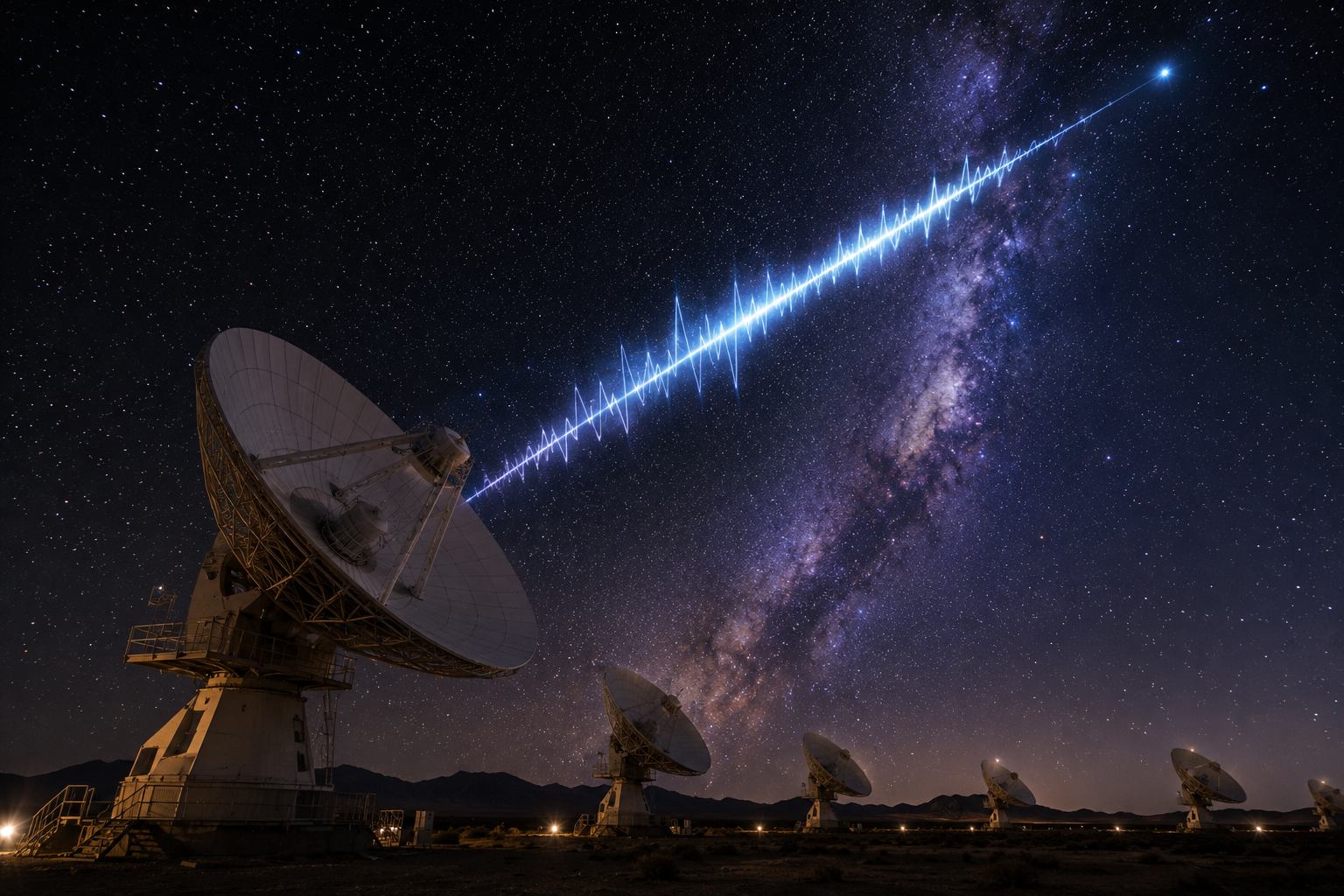
Astronomers have detected a powerful radio signal from deep space that is unlike anything they have seen before, raising fresh questions about some of the universe’s most mysterious cosmic events.
The signal belongs to a rare class of phenomena known as Fast Radio Bursts (FRBs) extremely bright flashes of radio waves that last only a fraction of a second. Although thousands have been detected over the past decade, scientists still do not know exactly what causes them.
What makes this latest discovery unusual is where the signal came from.
Using a network of radio telescopes, researchers traced the burst to the outskirts of a long-dead elliptical galaxy located billions of light-years from Earth.
Until now, most fast radio bursts had been linked to young, star-forming galaxies, where highly magnetised neutron stars, called magnetars, were thought to be the main source.
The finding suggests that fast radio bursts may have more than one origin.
“It changes the picture of where these mysterious signals can come from,” researchers said, noting that older galaxies were not expected to produce such energetic bursts.
Fast radio bursts were first discovered in 2007 and have since become one of astronomy’s biggest puzzles. In less than a millisecond, a single burst can release as much energy as the Sun emits over several days.
Yet by the time scientists detect one, it has already travelled across billions of years of space.
That journey makes every burst valuable.
As the radio waves pass through galaxies and clouds of gas, they carry information about the matter they encounter.
By studying these signals, astronomers can map otherwise invisible material spread across the universe and learn more about how galaxies evolved over billions of years.
The latest discovery is also prompting scientists to rethink existing theories. If fast radio bursts can originate from both young and ancient galaxies, researchers may need to explore additional sources beyond magnetars, including collisions between compact stars or other extreme cosmic events.
More powerful observatories, including the Square Kilometre Array (SKA) currently under construction, are expected to detect thousands more fast radio bursts every year.
Scientists hope the growing number of observations will finally reveal what produces these mysterious flashes and why they appear across such different environments.
For now, the newly detected signal has added another piece to a puzzle that remains far from solved, reminding astronomers that the universe continues to hold surprises even in places they thought they understood.