

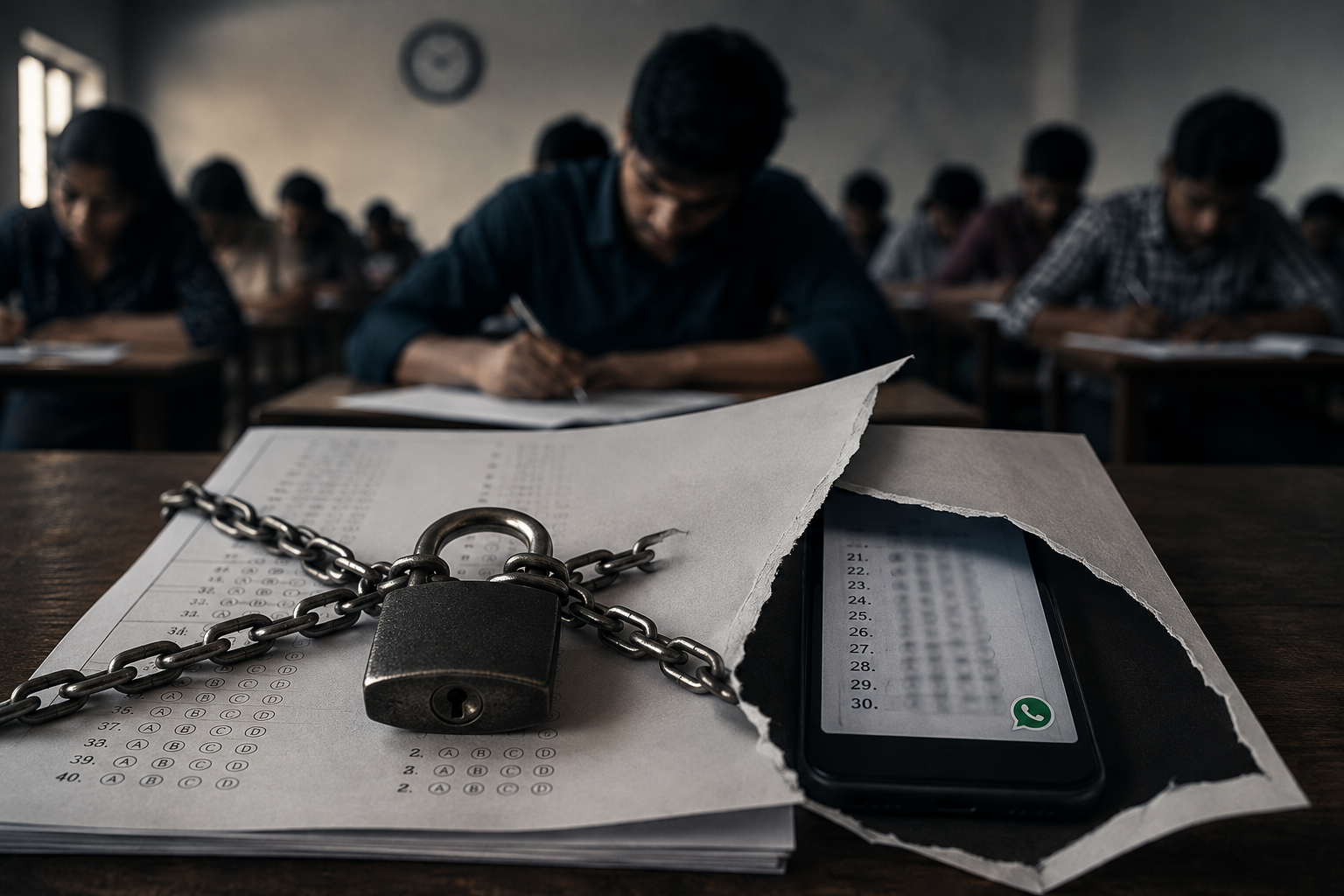
Every year, lakhs of young Indians sit examinations that could determine the course of their lives a government job, a medical seat, a teaching post or admission to a leading university. As Paper Leaks in India have become a recurring feature of the country’s examination system, months and often years of preparation can be undone before candidates even enter the examination hall.
Yet, year after year, some of these examinations are cancelled, not because students failed them, but because the question paper had allegedly been leaked before the exam even began.
This is no longer an isolated scandal. It has become a recurring pattern that has surfaced across states, examination boards and governments for more than a decade. The story is bigger than any single incident or political administration. It is about understanding why the same failures continue to occur despite repeated investigations, stricter laws and promises of reform.
The question is no longer whether another paper leak will happen. It is why the system remains vulnerable to them.
A pattern repeated across the country
Viewed in isolation, each paper leak appears to be a separate controversy. Viewed together, they reveal a systemic problem.
Between 2015 and 2023, India recorded more than 50 confirmed paper leak cases linked to government recruitment and competitive examinations across at least eight states, affecting an estimated 1.4 crore aspirants. These were not isolated security lapses but recurring failures that disrupted recruitment, delayed admissions and undermined confidence in public examinations.
Several cases illustrate the pattern.
Rajasthan recorded at least 14 paper leak cases between 2015 and 2023 across various recruitment examinations. Gujarat reported a similar number during the same period, including the 2022 Forest Guard recruitment examination and multiple Talati recruitment tests.
Uttar Pradesh witnessed at least six major paper leak cases between 2017 and 2022. The issue drew national attention in February 2024, when the state cancelled its Police Constable recruitment examination after allegations of a leak affected more than 48 lakh candidates, making it one of the largest cancelled recruitment examinations in the country’s history.
Telangana’s Public Service Commission paper leak in 2023 disrupted recruitment examinations for thousands of candidates, while Bihar has also faced repeated controversies, including the cancellation of its police constable recruitment examination the same year.
National-level examinations have proved equally vulnerable.
The NEET-UG 2024 medical entrance examination and the UGC-NET 2024 examination triggered nationwide protests, court proceedings and investigations by the Central Bureau of Investigation. In the NEET case, investigators alleged that organised networks operated with the assistance of individuals linked to examination centres, highlighting vulnerabilities that extended beyond external criminal groups.
The problem, however, did not begin in the age of smartphones or encrypted messaging platforms.
In 2015, the Supreme Court cancelled the All India Pre-Medical Test (AIPMT) after investigators uncovered a paper leak and organised cheating racket operating across multiple states. The case demonstrated that India’s examination system had structural weaknesses long before digital platforms enabled leaked papers to spread within minutes.
Technology has undoubtedly increased the speed and scale of paper leaks, but it did not create the problem. It exposed weaknesses that had existed for years.
Repeated often enough, these incidents become more than administrative failures. They begin to erode confidence in a system built on a simple promise—that merit, not manipulation, should determine opportunity.
Why the system keeps failing
Understanding how a paper leak occurs helps explain why the problem has proved so difficult to eliminate. In most cases, a leak is not the result of a single security breach but the final failure in a chain of processes that begins long before candidates enter the examination hall.
A question paper typically passes through several stages before an exam is conducted. It is prepared by subject experts, printed at authorised facilities, transported to examination centres, stored under secure custody and finally distributed to invigilators. Every stage is designed to protect confidentiality, but every transfer of responsibility also creates another point where security can fail.
Investigations over the years have shown that these vulnerabilities are spread across the system rather than concentrated at a single point.
The printing stage is one example. Many examination authorities depend on outsourced private presses to print confidential papers. While these facilities are expected to follow strict security protocols, the involvement of multiple vendors and personnel increases the risk of unauthorised access.
Transportation presents another challenge. Question papers often pass through several layers of custody before reaching examination centres. Every handover requires absolute compliance with security procedures, yet each transfer also expands the opportunity for human error or deliberate misconduct.
The examination centre itself has repeatedly emerged as another weak link. Investigations in several states have alleged the involvement of invigilators, centre superintendents and other officials entrusted with conducting examinations. These cases suggest that the threat does not always come from outsiders attempting to breach the system but can also originate from within the system itself.
Technology has magnified the consequences of these failures. A single photograph of a question paper can now be shared with thousands of candidates within minutes through encrypted messaging platforms, turning what might once have been a local security lapse into a nationwide controversy.
The NEET-UG 2024 investigation reflected this broader challenge. According to investigators, the alleged network involved not only organised criminal groups but also individuals connected to examination centres. The case reinforced a recurring finding from previous investigations: the greatest vulnerability often lies not in the technology used to circulate leaked papers but in the human chain responsible for protecting them.
These recurring failures point to deeper structural issues.
One is the growing dependence on outsourced services. Printing, logistics and transportation for large-scale examinations often involve multiple private contractors. While outsourcing is necessary for examinations conducted at such scale, it can also fragment accountability when security is compromised.
Another challenge is the chain of custody. Question papers typically change hands multiple times before reaching candidates. Unlike high-security sectors such as banking, election management or defence logistics, many examination systems still rely heavily on manual processes where confidentiality depends as much on individual integrity as on institutional safeguards.
Financial incentives have also fuelled organised examination fraud. Investigations across several states have uncovered so-called “solver gangs” that specialise in obtaining leaked papers and selling them to candidates. In highly competitive examinations, where a government job or professional degree can transform a person’s future, the illegal market for leaked question papers can generate enormous profits.
The scale of India’s examination system makes these vulnerabilities even harder to manage. Examinations such as NEET are conducted for millions of candidates across thousands of centres on a single day. Coordinating an exercise of this magnitude requires an extensive network of personnel and infrastructure, leaving very little room for error.
Taken together, these factors explain why paper leaks continue to recur despite repeated investigations, arrests and tougher laws. The names of the examinations, the governments and the investigating agencies may change, but the underlying vulnerabilities have remained remarkably consistent. Until those structural weaknesses are addressed, the cycle is likely to continue an alleged leak, a cancelled examination, a fresh investigation and another promise of reform.
The cost beyond a cancelled examination
Every paper leak leaves behind more than a cancelled examination. It disrupts lives that have often been built around years of preparation.
For many aspirants, a competitive examination represents far more than a single test. Families invest their savings in coaching, accommodation, study materials and travel, hoping that one successful attempt will secure admission to a professional course or a stable government job. When an examination is cancelled, those investments cannot be recovered. Candidates are simply asked to prepare again.
The consequences are often measured in time as much as money. Recruitment delays can postpone employment by months, while students preparing for entrance examinations may lose an academic year. Those approaching the upper age limit for government recruitment face an added uncertainty over whether they will remain eligible when fresh examinations are announced.
The psychological impact is harder to measure but equally significant. India’s competitive examination system already places enormous pressure on students. Long preparation cycles, intense competition and uncertainty are part of the experience for millions of aspirants. Repeated cancellations and allegations of paper leaks add another layer of stress to an already demanding process.
Mental health experts have repeatedly called for greater attention to the wellbeing of students preparing for high-stakes examinations. While anxiety, depression and student suicides cannot be attributed to paper leaks alone, repeated disruptions can deepen uncertainty for candidates whose futures often depend on a single examination.
Perhaps the greatest loss is one that cannot be quantified.
Competitive examinations are built on the promise that merit determines opportunity. Every paper leak weakens that promise. When candidates begin to question whether hard work alone is enough, confidence in the fairness of the system begins to erode. Restoring that trust may prove even more difficult than preventing the next paper leak.
Can tougher laws solve the problem?
The latest chapter in India’s paper leak crisis unfolded with the controversy surrounding NEET-UG 2026, where allegations of question paper leaks and examination malpractice once again triggered nationwide concern over the integrity of one of the country’s most important entrance examinations. Although investigations are continuing, the controversy reignited a familiar debate: despite repeated reforms, why does India’s examination system remain vulnerable to the same failures?
The political response was swift.
Building on the Public Examinations (Prevention of Unfair Means) Act, 2024, Parliament has now passed the Public Examinations (Prevention of Unfair Means) Amendment Bill, 2026, strengthening the legal framework against organised examination fraud.
The amendments significantly increase penalties for organised paper leak networks and introduce stricter timelines for investigations and trials. The revised law also provides for substantially higher financial penalties, enhanced accountability for institutions and service providers involved in conducting examinations, and a stronger focus on dismantling organised criminal networks rather than prosecuting only individual offenders.
The message is clear: paper leaks are no longer being treated as isolated cases of cheating but as organised crimes capable of undermining public institutions, delaying recruitment and affecting the futures of millions of students.
Yet the central question remains unchanged.
Can tougher laws prevent the next paper leak?
The answer is more complicated than simply increasing punishments.
Laws come into effect after a crime has already been committed. They can raise the cost of breaking the law and strengthen investigators’ ability to prosecute offenders, but they do not automatically remove the vulnerabilities that allow a leak to occur in the first place.
A tougher sentence offers limited reassurance if confidential question papers continue to pass through multiple stages of printing, transportation and storage before reaching candidates. Similarly, faster investigations matter only if security failures are identified early enough to prevent another breach rather than merely explain the previous one.
That is why many education and governance experts argue that prevention deserves as much attention as punishment.
Many large-scale international testing systems have reduced the movement of physical question papers by adopting computer-based examinations with encrypted digital question delivery. Others have introduced digital chain-of-custody systems that record every stage at which confidential material changes hands, making it easier to identify where a breach occurred.
Some examination authorities also use multiple versions of the same question paper, limiting the impact of a single compromised set, while independent security audits help identify weaknesses before an examination is conducted rather than after it has failed.
India’s examination authorities—including the National Testing Agency (NTA), the Union Public Service Commission (UPSC), the Staff Selection Commission (SSC) and various state public service commissions—conduct examinations for millions of candidates across thousands of centres every year. That scale presents logistical challenges unmatched in much of the world, making strong security systems not simply desirable but essential.
The new law undoubtedly marks the toughest legal response India has introduced against paper leaks. Whether it proves effective, however, will depend not only on the severity of punishment but also on whether the structural weaknesses that have enabled leaks for more than a decade are finally addressed.
Beyond the leak: What is really at stake?
When a paper leak makes headlines, public attention often focuses on the immediate fallout—an examination is cancelled, arrests are made, investigations begin and a new date is announced. But the consequences extend well beyond a disrupted examination.
India’s public examination system is one of the country’s largest merit-based institutions. Every year, millions of students and job aspirants compete under a common set of rules for opportunities that can shape their education, careers and financial futures. The credibility of that system depends not only on conducting examinations efficiently but also on ensuring that every candidate competes on equal terms.
That responsibility is shared across multiple institutions. National agencies such as the National Testing Agency (NTA), the Union Public Service Commission (UPSC) and the Staff Selection Commission (SSC), along with state public service commissions, recruitment boards, private printing contractors, logistics providers and examination centres, all form part of the examination ecosystem. A weakness at any stage can compromise the integrity of the entire process.
This is also why accountability becomes difficult after a paper leak. Investigations may identify those directly involved in obtaining or distributing question papers, but they also raise broader questions. Were security protocols adequate? Were private vendors properly vetted? Were custody procedures followed? Could warning signs have been detected earlier? Answering these questions is just as important as prosecuting those responsible.
The challenge, therefore, is not simply to punish individual offenders but to strengthen the system that allowed the breach to occur.
Recent legal reforms represent an important step in that direction, but legislation alone cannot restore public confidence. Trust is built when examinations are conducted without controversy, recruitment is completed on time and candidates believe that their performance not access to leaked papers determines the outcome.
That is perhaps the most significant lesson from the past decade. Paper leaks are not merely law-and-order issues or administrative lapses. They test the credibility of institutions that millions of young Indians rely on every year.
The bottom line
India’s paper leak crisis is bigger than any single examination, recruitment board or government. It reflects the challenges of managing one of the world’s largest examination systems while protecting the integrity of a process that affects millions of lives.
The legal response has become tougher. Investigations have become more coordinated. Public scrutiny has intensified. Yet the recurring nature of paper leaks suggests that punishment alone cannot solve a problem rooted in process, accountability and institutional capacity.
Ultimately, every competitive examination rests on a simple promise: that every candidate begins with an equal opportunity to succeed.
Protecting that promise is not only about preventing the next paper leak. It is about preserving confidence in a system where merit is expected to matter above everything else.