

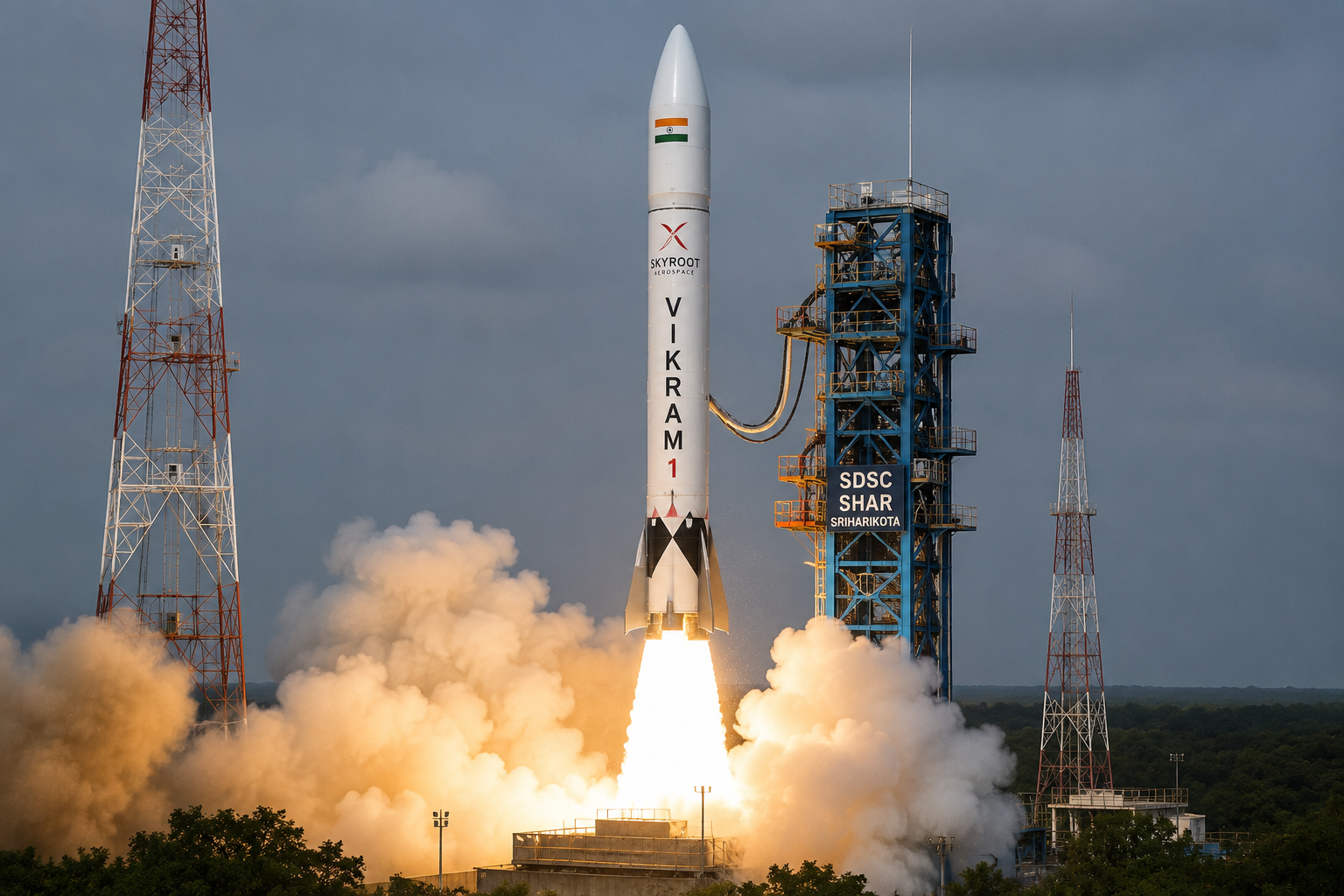
India’s space programme has entered a new era after Skyroot Aerospace successfully placed its Vikram-1 rocket into orbit, becoming the first private Indian company to achieve an orbital launch from Indian soil. The mission lifted off from the Satish Dhawan Space Centre in Sriharikota, carrying multiple payloads into low Earth orbit.
The launch is more than a milestone for one company. It is the clearest sign yet that India’s space reforms are beginning to reshape the sector, with private firms moving from building components to conducting complete orbital missions. Until recently, launches of this scale were carried out exclusively by the Indian Space Research Organisation (ISRO).
Vikram-1 carried technology demonstration payloads, including two satellites, as part of a mission designed to validate the rocket’s performance. The data collected from the flight will help Skyroot refine future launches as it aims to establish regular commercial services for domestic and international customers.
The success also highlights how India’s commercial space ambitions are evolving. Global demand for launching small satellites has grown rapidly in recent years as governments, research institutions and businesses rely more heavily on space-based communications, Earth observation and navigation services. Indian start-ups are hoping to secure a share of that expanding market by offering competitive launch services.
The achievement comes as ISRO continues to focus on major national missions, including Gaganyaan and advanced scientific programmes. With private companies now handling more commercial activities, the country’s space ecosystem is becoming broader rather than being centred on a single organisation.
The challenge now shifts from proving the technology to building a sustainable business. A successful first launch is an important achievement, but regular launches, customer confidence and international contracts will determine whether Indian private launch companies can compete in the global market over the long term.
For India’s space sector, Vikram-1 is significant not simply because another rocket reached orbit, but because it demonstrates that commercial spaceflight is beginning to take root alongside the country’s government-led programme.