


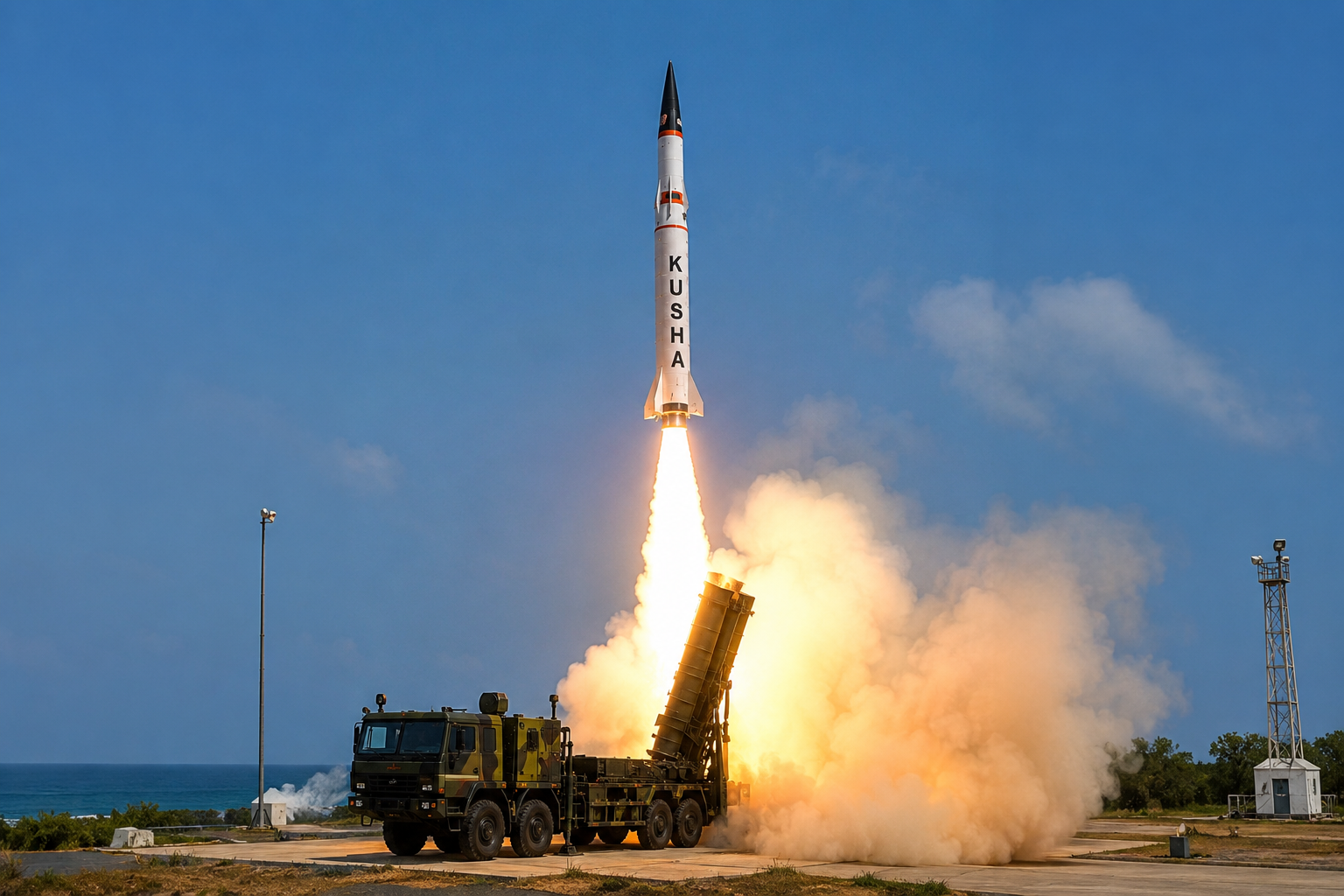
New Delhi: India has taken a major step towards strengthening its indigenous air defence capability after the Defence Research and Development Organisation (DRDO) successfully carried out the maiden flight test of the Kusha long-range surface-to-air missile.
The test was conducted from Dr APJ Abdul Kalam Island off the Odisha coast. According to the Ministry of Defence, the missile was launched against an electronic target simulating a high-speed, high-altitude aerial threat.
The Kusha system successfully intercepted the target, validating key technologies including guidance, tracking and interception capabilities during its first developmental flight.
Project Kusha is India’s indigenous long-range air defence programme designed to provide layered protection against fighter aircraft, cruise missiles, drones and other airborne threats.
The missile system is being developed in multiple variants with interception ranges extending up to 350–400 kilometres, reducing dependence on imported long-range air defence systems.
The programme is expected to play a key role in India’s future integrated air defence network.
Approved by the Cabinet Committee on Security in 2022, the project is slated for phased induction between 2028 and 2030, with five squadrons already cleared for procurement by the Indian Air Force.
Defence officials described the successful trial as an important milestone in advancing India’s self-reliance in strategic defence technologies and strengthening its capability to counter evolving aerial threats.