

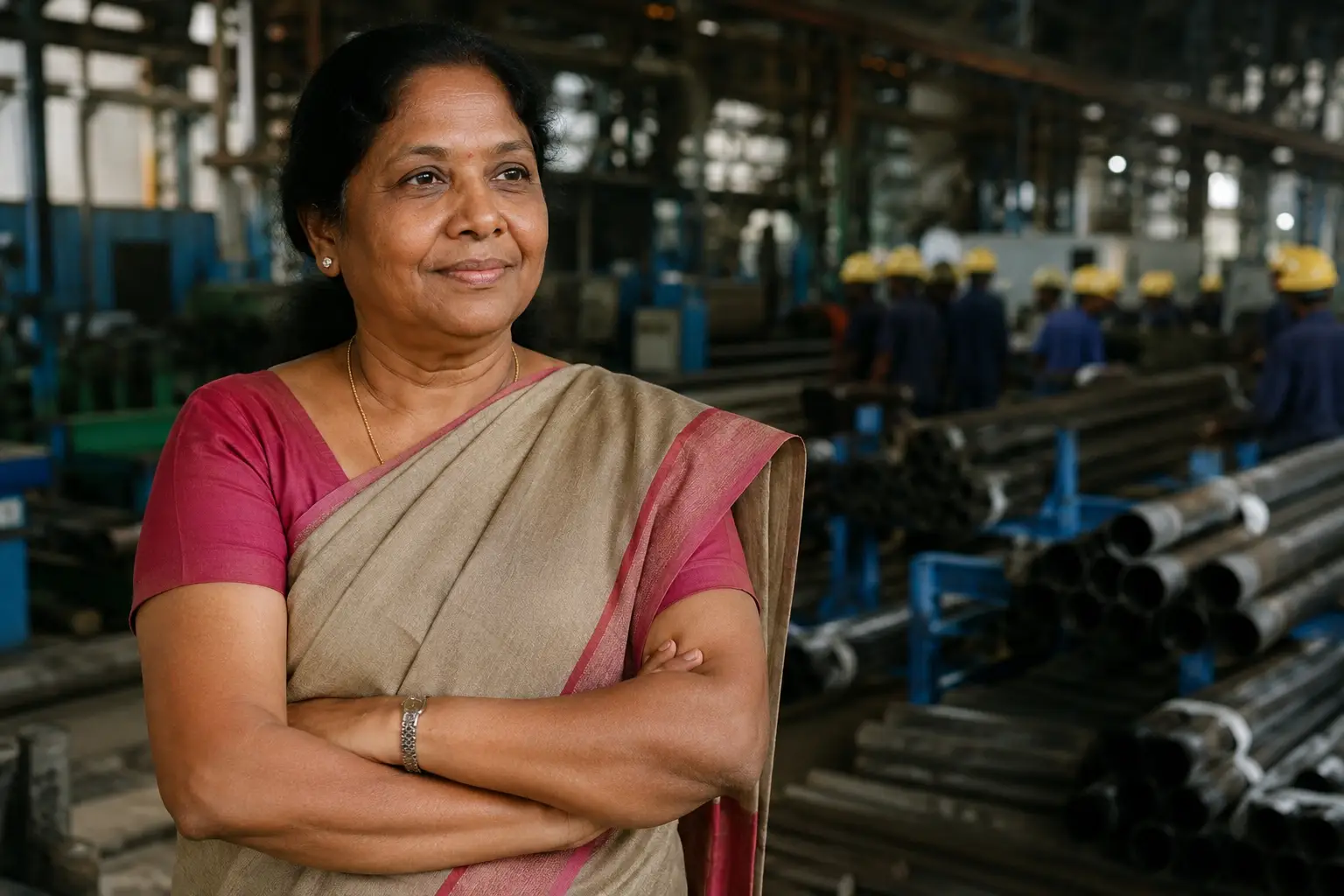
When people speak about India’s most remarkable entrepreneurs, Kalpana Saroj’s name often comes up with quiet admiration.
As Chairperson of Kamani Tubes Limited a company founded in 1959 by industrialist Ramjibhai Kamani she helped bring back a business that many believed would never recover. In 2013, the Government of India honoured her with the Padma Shri for her contribution to trade and industry.
Today, her journey is studied in business schools and celebrated as one of India’s most inspiring stories of resilience.
Yet, if you had met Kalpana six decades earlier, you would never have imagined such a future.
In 1961, she was born in Roperkheda, a small village in Akola district, Maharashtra.
The village was quiet, where mornings began with the sounds of people leaving for work and evenings settled long before the sun disappeared. Her father served as a police constable, and his modest salary supported the family. There was no abundance, but there was dignity, hard work and the hope that education might open doors that life had kept closed for generations.
For young Kalpana, school was more than a place to study.
It was where her world felt bigger than the village around her.
She loved sitting in the classroom, listening to her teachers and imagining the future, even if she didn’t yet know what that future looked like. Like any other child, she believed there would be another school day tomorrow.
There wasn’t.
When Kalpana was 12 years old, while she was still studying, her family arranged her marriage a practice that was common in parts of rural India during the early 1970s. In what felt like a single moment, childhood quietly stepped aside. The books she loved were put away, and a new life began before she had the chance to understand it.
She entered her husband’s home hoping to find acceptance.
Instead, she found hardship.
Years later, Kalpana would speak openly about the physical and emotional abuse she endured during those months. When her father saw what his daughter was going through, he brought her back to Roperkheda.
Coming home should have felt like a new beginning.
But sometimes, the hardest battles are not fought behind closed doors they are fought in front of people who think they already know your story.
Some neighbours lowered their voices as she walked by.
Others looked at her with sympathy.
A few judged her without asking a single question.
For a girl who had barely entered her teenage years, those silent glances often hurt more than spoken words.
There were days when the future felt impossible to see.
In later interviews, Kalpana revealed that she attempted to take her own life by consuming poison. She survived. Looking back, she has described that period as the darkest chapter of her life.
Time, however, has a quiet way of changing even the stories that seem beyond repair.
As Kalpana slowly recovered, one thought stayed with her.
If life was ever going to change, she could not spend it waiting for someone else to change it.
With little more than courage and determination, she left Roperkheda for Mumbai.
She carried no wealth, no influential connections and no carefully drawn business plan.
She carried something less visible, but far more powerful.
The belief that somewhere beyond the familiar roads of her village, another life was waiting to be built.