

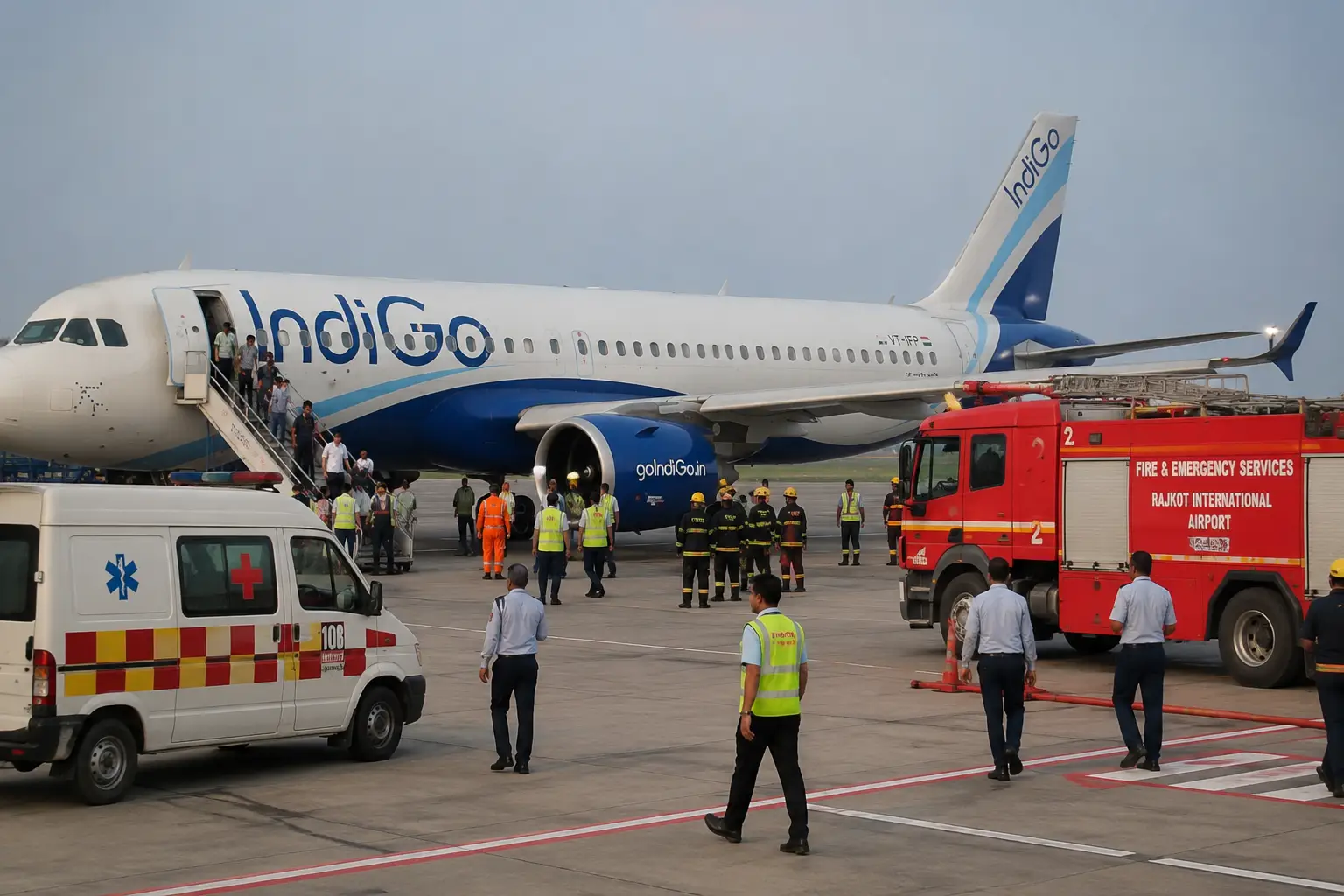
Passengers on an IndiGo flight from Dubai to Mumbai had an anxious journey on Monday after the aircraft made an emergency landing at Rajkot International Airport following a smoke alert in the cargo hold. The flight landed safely, and all 194 passengers and crew members were evacuated without injuries.
Airport authorities declared a full emergency after the crew reported smoke, allowing fire services, ambulances and rescue teams to be positioned before the aircraft touched down. Officials said the diversion was a precautionary measure while the aircraft undergoes inspection to determine what triggered the alert.
While the term “emergency landing” often raises fears of a near-disaster, aviation experts note that it is a standard safety procedure whenever pilots detect a possible onboard risk.
Modern aircraft are designed with multiple backup systems, and flight crews are trained to divert to the nearest suitable airport rather than continue flying when there is any uncertainty about safety.
A smoke warning inside the cargo hold is treated seriously because the source may not be immediately known. It could range from a technical malfunction to an overheating item in the cargo compartment. In such situations, international aviation procedures require pilots to prioritise a safe landing over completing the scheduled journey.
The Rajkot incident is another reminder that aviation safety depends as much on precaution as it does on technology. The decision to divert may inconvenience passengers, but it reflects a system designed to minimise risk long before an emergency can escalate.
Investigators are expected to examine the aircraft before determining the exact cause of the smoke alert.